 CalcCommons
How to use
Choose the question that matches your problem, then enter X and Y in the order shown. For increase and decrease, X is the original value and Y is the new value. Calculate to see the result and substituted arithmetic.
For related tasks, try the Fraction Calculator.
Formula & how it works
X% of Y = X × Y/100. Percent change = (new − original)/original × 100. Percent difference = |X − Y| ÷ ((X + Y)/2) × 100.
Worked examples
Example 1
20% of 150 = 20 ÷ 100 × 150 = 30.
Example 2
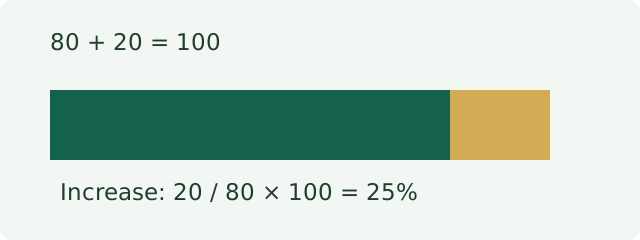
An increase from 80 to 100 is (100 − 80) ÷ 80 × 100 = 25%. The percentage difference is 20 ÷ 90 × 100 = 22.2222%.
Assumptions & practical notes
Change modes require a positive original value. Difference uses nonnegative values and their average as the denominator.
Percentage points are an absolute subtraction: moving from 20% to 25% is 5 percentage points, but a 25% relative increase.
See our calculation methodology for unit definitions and testing practices.
Frequently asked questions
Why does reversing a change give a different percentage?
The denominator changes. A rise from 80 to 100 is 25%; returning from 100 to 80 is a 20% decrease.
Can the base be zero?
No for division-based percentages. A percent of zero is zero, but a change from zero has no finite percentage.
Related calculators
Fraction Calculator
Add, subtract, multiply, divide, and convert fractions, mixed numbers, and decimals.
Grade Calculator
Calculate points-based or weighted grades, average assignments, and make a quick grading table.
Average Calculator
Find the arithmetic mean, sum, count, minimum, and maximum of a number list.