 CalcCommons
How to use
Choose an operation and enter fractions such as 3/4, mixed numbers such as 1 1/2, or decimals such as 0.125. Convert uses just the first number. Set your maximum exact denominator, then calculate to see simplified, mixed, and decimal forms.
For related tasks, try the Percentage Calculator.
Formula & how it works
a/b + c/d = (ad + bc)/bd; subtraction changes + to −. Multiplication gives ac/bd; division gives ad/bc. Divide numerator and denominator by their greatest common divisor.
Worked examples
Example 1
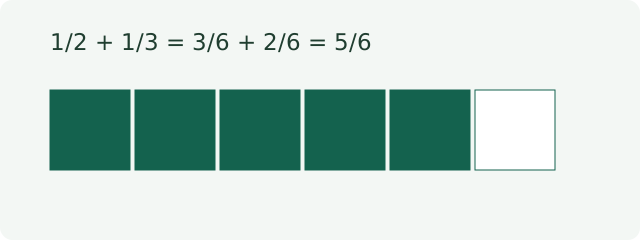
1/2 + 1/3 = (3 + 2)/6 = 5/6 = 0.8333…
Example 2
1 1/2 ÷ 3/4 = 3/2 × 4/3 = 12/6 = 2. Decimal 0.125 reduces to 1/8.
Assumptions & practical notes
Exact integer arithmetic is used for fractions. Decimal input supports 12 places; the maximum denominator rejects results that exceed your selected limit instead of silently approximating.
For a negative mixed number, −1 1/2 means −(1 + 1/2). A denominator and the divisor fraction must not be zero.
See our calculation methodology for unit definitions and testing practices.
Frequently asked questions
Can I enter an improper fraction?
Yes. For example, 7/3 is also shown as 2 1/3.
Why was my decimal rejected?
The exact fraction may exceed your denominator limit or the input may contain more than 12 decimal places. Increase the limit or shorten the decimal.
Related calculators
Percentage Calculator
Solve percent-of, percentage change, reverse percentage, and percentage difference problems.
Long Division Calculator
Divide nonnegative whole numbers with a quotient, remainder, and generated division steps.
Average Calculator
Find the arithmetic mean, sum, count, minimum, and maximum of a number list.