 CalcCommons
How to use
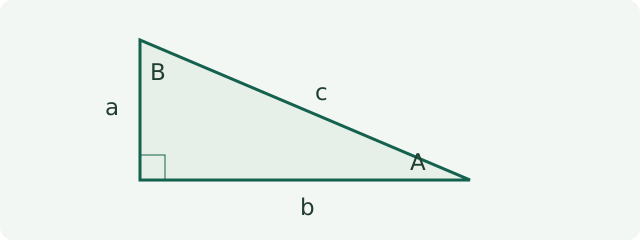
Select the pair of known measurements. Enter the first side as X and the second side or angle A as Y. Side c is the hypotenuse; A is opposite side a. Use degrees for angles and the same length unit for every side.
For related tasks, try the Area Calculator.
Formula & how it works
a² + b² = c². sin A = a/c; cos A = b/c; tan A = a/b. Area = ab/2; perimeter = a + b + c.
Worked example
Example 1
Legs 3 and 4 give hypotenuse 5, area 6, perimeter 12, angle A ≈ 36.8699°, and angle B ≈ 53.1301°.
Assumptions & practical notes
The triangle must contain a right angle. Side c is always the hypotenuse, and angle A is opposite side a.
Use one consistent length unit; area will be in its square units. Acute angles must be strictly between 0° and 90°.
See our calculation methodology for unit definitions and testing practices.
Frequently asked questions
Why must c be longer than a leg?
The hypotenuse is opposite the right angle and is the longest side.
Can I solve from one side alone?
No. Another independent side or acute angle is needed.
Related calculators
Area Calculator
Calculate the area of six geometric shapes with conversions to common square units.
Factoring Calculator
Find integer factors, greatest common factors, and rational factors of quadratic trinomials.
Percentage Calculator
Solve percent-of, percentage change, reverse percentage, and percentage difference problems.